Not denying because endorsing
Call the spade a spade
Elon Musk Nazism is dangerous
When video emerged of Elon Musk giving a Nazi salute at a political rally, his response was telling: He never denied it.
Never denied this, not even once. When falsely accused of making an obvious Nazi salute, most people’s immediate response would be “I absolutely did not do that.” Instead, Musk’s response was to spin it into a “dirty tricks campaign” that never actually denies doing it.
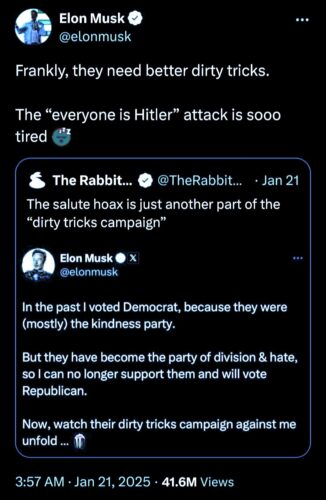
Think about these tactics carefully. He didn’t say “I didn’t give a Nazi salute.” He didn’t say “That’s not what happened.” He certainly didn’t say “I stand opposed to racism and hate.” He attacked people daring to point out his Nazi salute, claiming he wants “better dirty tricks” from them.
This is straight from the Nazi propaganda playbook portraying their targets as dishonest and manipulative. When Hitler was tried for the Beer Hall Putsch in 1923, he didn’t deny trying to overthrow the government. Instead, he turned his trial into a platform to attack his accusers, claiming they were the threat to Germany instead of him.
Musk is playing an even more dangerous game. By dismissing Nazi comparisons as “sooo tired” while never denying his apparent Nazi salute, he’s sending a clear message: being called a Nazi is worse than actually behaving like one.
Notice another sleight of hand: he complains about “the everyone is Hitler attack” – yet nobody said “everyone.” They said Musk, specifically, made a Nazi salute. By pretending this is about “everyone” being called Hitler, he’s creating a straw man to discredit his critics while still never denying what he actually did. It’s deflection through exaggeration – make the accusation sound ridiculous by pretending it’s broader than it is.
This is how extremism gets normalized – not through outright endorsement, but through strategic non-denials turned into attacks. Attack those who point out extremist behavior, while letting the behavior itself slide as if what everyone sees isn’t real. It’s a form of winking acknowledgment to supporters while maintaining plausible deniability.
Even more disturbing is Musk’s specific choice of words. His repeated use of “dirty tricks” echoes classic Nazi antisemitic propaganda, which routinely relied on the German word for “dirty” (schmutzig) to dehumanize Jewish people. White supremacist hate groups typically promote the trope that Jews are involved in “dirty tricks” to control or subvert society for their own benefit, based in long-standing anti-Semitic stereotypes.
Thus Musk’s response wasn’t casual language – it was a deliberate propaganda tool to invoke Nazi themes about Jews being “unclean” or “impure.” When Musk calls for “better dirty tricks,” he’s not just refusing to deny his Nazi salute – he’s actively whistling Nazi-era antisemitic language while doing so.
Further historical echoes are impossible to ignore. After Kristallnacht in 1938, the Nazi leadership didn’t deny organizing the violence against Jewish citizens. Instead, they blamed the victims for “provoking” it. Don’t deny the action – just attack those who criticize it and claim victimhood.
When someone with Musk’s massive platform plays these games, the stakes become enormous. His claim about leaving the “kindness party” becomes even more sinister when paired with his use of Nazi-era antisemitic language. He’s not just switching political parties – he’s embracing and amplifying extremist rhetoric while playing the victim.
This is about more than one gesture or one tweet. It’s about more than years of evidence that Elon Musk promotes Nazism. It’s about recognizing how extremism spreads in the digital age. Not through outright statements, but through strategic non-denials and attacks on critics.
When influential figures refuse to deny their extremist actions and instead attack those who dare to point them out, they’re doing more than defending themselves – they’re normalizing the indefensible.
History shows us exactly where this leads. The only question is whether we’ll stop it in time to avoid the end of democracy.
UPDATE January 23, 2025: Two days after giving a Nazi salute and facing limited pushback, Musk moved from non-denial to open endorsement, posting a series of “jokes” using the names of Nazi leaders.
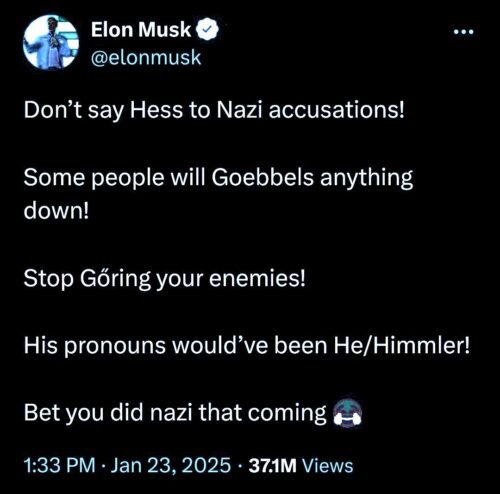
Let’s be crystal clear: These aren’t just puns. This is Musk admitting it was a Nazi salute. He is literally mocking anyone who wasn’t sure he made a Nazi salute, laughing at them. Emboldened by insufficient resistance to his initial act, he’s now comfortable enough to openly promote light humor about genocidal Nazi leaders – Hess, Goebbels, Göring, and Himmler – to his 37 million viewers.
This is exactly how extremism advances: Test the waters with a Nazi salute. When the response is muted, escalate to openly referencing Nazi leaders. Test the door handle. If it’s unlocked, burst out laughing. His “bet you did nazi that coming” isn’t just a sad pun to draw viewers – it’s a boast. He’s saluting to militant extremist domestic terrorism cells, saying look how easy it was for him to be allowed by his confused targets to escalate from implicit to explicit Nazi messaging.
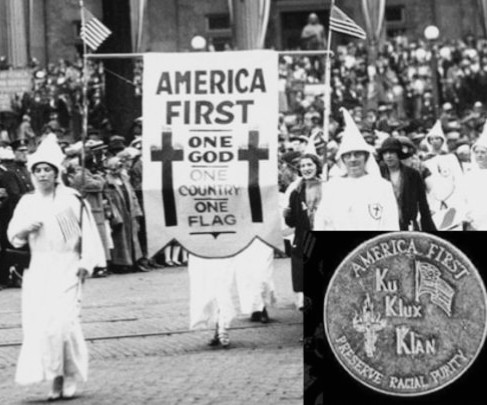
What started as “just don’t deny it” has within a day become “joke about it” and “laugh about it.” The progression is textbook: deny nothing, mock critics, then openly embrace Nazi ideology. Next comes racist violence disguised as “self defense” – a tactic perfected by “America First” movements from the 1800s through the 1900s. This is deeply American, not new. Fire bombing of Black Wall Street, coordinated state violence against labor unions, concentration camps for Japanese Americans, mass graves of indigenous peoples… Nazi “innovations” were actually imitations of American presidential policies under Jackson, Polk, and Wilson. America was more than a blueprint for Nazi Germany’s atrocities, as Hitler explicitly praised American race laws in “Mein Kampf” and told the world he would implement the anti-semitic violence Henry Ford encouraged. Now Musk, himself an illegal immigrant who exploited open borders to launder his family’s blood-stained apartheid fortunes, is cynically activating the most sinister meaning of MAGA’s “again”: the return to state-sanctioned racial terror.

Hitler was Austrian, not German. His background, like Musk’s South African one, demonstrates outsiders exploiting and amplifying existing nationalist extremism targeting… outsiders.
This is how it happens. This is how it’s happening.
Trump’s team failed to execute their first attempt, but they told us their Nazi playbook openly in 2016.
Like [President] Jackson’s [racist genocidal] populism, we’re going to build an entirely new political movement…. We’re just going to throw it up against the wall and see if it sticks. It will be as exciting as the 1930s.
When Bannon proclaimed they would build a movement like the 1930s while praising Jackson’s violent populism, he wasn’t referencing New Deal – a laughable claim given his consistent condemnation of liberalism as a decline into communism. No, he was explicitly signaling his hope for fascism’s rise, testing the waters just as Musk does now.
This pattern didn’t start with Musk, he’s merely the latest to perfect and amplify it: speak in code, gauge reaction, then escalate attacks. They’re accelerating far faster than 2016, learning from Hitler’s evolution from failed 1923 putsch and criminal charges to 1933 dictatorship. That’s why they are centralizing while deregulating everything immediately, for big tech to monopolize society in order to drive harms faster and deeper than their first attempt.
And we’re running out of time to stop it.
Update: A subsequent tweet perfectly illustrates the pattern. Rather than addressing concerns about Nazi symbolism, Musk deploys classic propaganda tactics by creating a false equivalence – labeling his critics as “radical leftists” who praise Hamas. The timing (3:37 AM) and massive reach (78.4M views) demonstrate a deliberate strategy to maximize exposure while making substantive discussion impossible.
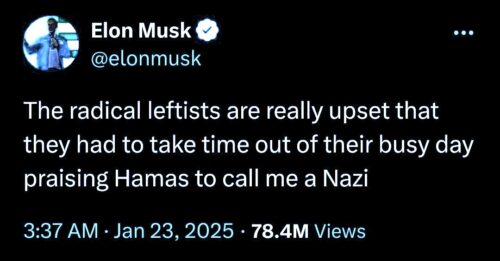
This continues the progression the article has traced: from non-denial to mockery to attacking critics through inflammatory comparisons. By falsely pitting criticism of Nazi symbolism against support for Hamas, a totally false choice, the tweet creates an artificial conflict designed to seduce Jewish critics into defending Musk’s Nazi salute – a particularly insidious tactic given that both Hamas and Musk have documented histories of promoting Nazi ideology.
Nazi Germany was able to insinuate its exterminationist antisemitism into the Middle East and how that influence continues to poison Arab and especially Palestinian views of Israelis and Jews in general.
To stand against Musk giving his Nazi salute, let alone his copious dissemination of Nazi merch and symbolism over the years such as rebranding Twitter with a swastika, would therefore mean to also stand against Hamas. For him to say a stand against him is for Hamas is to setup a trap far too many Jews will fall into. This new tweet further normalizes extremist rhetoric through strategic deflection and plan for dangerous further escalation, all while avoiding any direct denial or accountability.